/logo.png)


- By Admin
- 18 July, 2025
- 6 min read
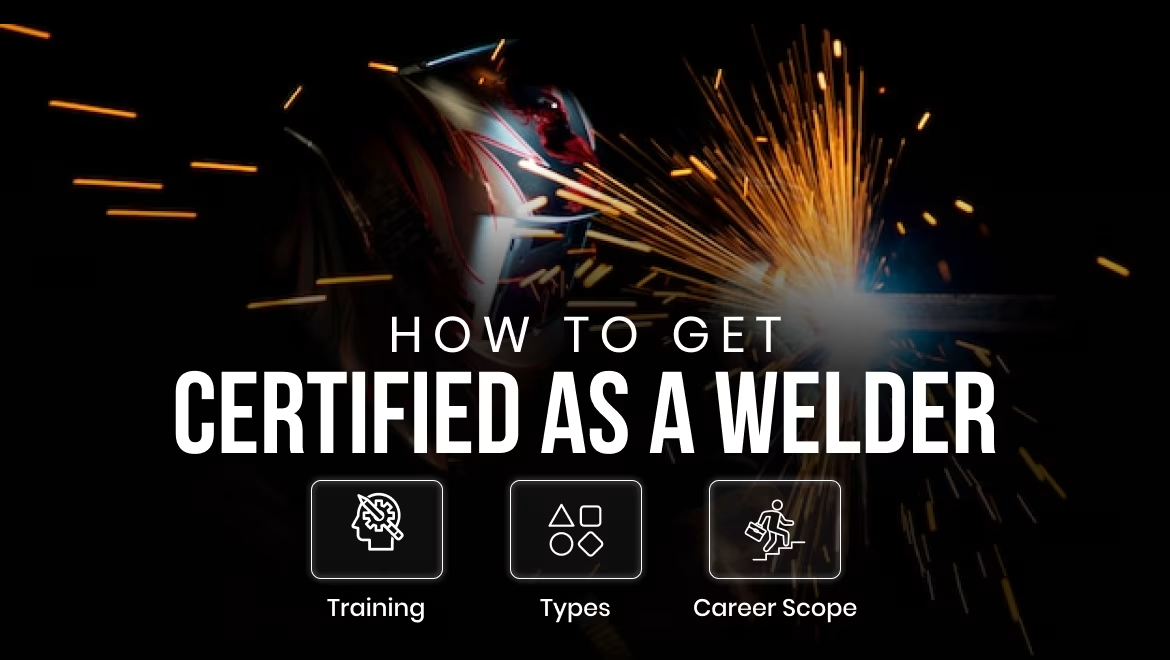
How to Get Certified as a Welder: Training, Types & Career Scope
1. What is Welding Certification?
Welding certification is a formal process that validates a welder’s skills and knowledge to perform specific types of welds under defined standards. This certification ensures the welder can deliver work that meets safety, structural, and industry requirements. Certifications are often provided by recognized bodies like the American Welding Society (AWS) or local government-authorized institutions in India.
For those searching welder programs near me, understanding what welding certification is—and why it matters—is the first step toward a skilled trade career.
2. Why is Welding Certification Essential?
Welding is a high-precision, high-responsibility profession. Whether you're working in construction, shipbuilding, oil & gas, or manufacturing, the integrity of a weld directly impacts the safety and longevity of the structure. Here’s why welding certification classes are essential:
- Credibility: Certified welders are more likely to be trusted by employers and clients.
- Legal Compliance: In many sectors, only certified welders are legally allowed to work on certain jobs.
- Career Growth: Many supervisory or specialized roles require certification.
- Skill Validation: Certification confirms your competence in a specific welding process, material, or position.
3. Ensures Quality and Safety: The Role of Certified Welders
Certified welders are trained not only to perform precise welds but also to follow safety protocols that protect themselves, others, and the structure they’re working on. Poor welding can lead to catastrophic failures—especially in critical infrastructures like bridges, boilers, or oil pipelines.
A certified welder ensures:
- Structural integrity of projects
- Minimized risk of accidents
- Compliance with ISO and ASME standards
- Increased efficiency and reduced rework
Moreover, certified welders are often first in line for job openings in industries such as:
- Construction and Infrastructure
- Shipyards and Refineries
- Automotive and Aerospace
- Energy and Power Plants
4. Types of Welding Certifications
Welding certification isn't one-size-fits-all. Depending on your career goals, you may need to pursue one or more of the following:
a. Shielded Metal Arc Welding (SMAW) Certification
Also known as stick welding, this is common in construction and pipelines.
b. Gas Tungsten Arc Welding (GTAW/TIG)
Used in aerospace and automotive, it offers high precision for thin metals.
c. Gas Metal Arc Welding (GMAW/MIG)
Frequently used in manufacturing and fabrication.
d. Flux-Cored Arc Welding (FCAW)
Suited for heavy equipment and industrial applications.
e. Structural Welding Certifications (AWS D1.1)
Critical for infrastructure and building projects.
Each certification type trains and tests welders on specific positions (flat, horizontal, vertical, or overhead) and materials (steel, stainless steel, aluminum, etc.).
5. How to Get Certified in Welding
Getting certified involves the following steps:
1. Enroll in a Certified Program
Look for NSDC-approved or ITI-recognized welding training centres in your locality. Searching welder programs near me online with location filters (e.g., West Bengal) can help you find nearby institutions.
2. Complete Welding Training
Courses include both classroom instruction and hands-on welding practice. Topics covered may include welding theory, blueprint reading, safety procedures, and metallurgy.
3. Pass the Certification Exam
Certification typically involves a practical exam supervised by a certified welding inspector. Welds are tested using destructive or non-destructive methods.
4. Receive Your Certification
Once qualified, you’ll receive a certificate valid for a specific duration (usually 6 months to 3 years), after which renewal or re-testing may be required.
6. Types of Welders
Welders often specialize based on the industries they serve or the methods they use. Common types include:
- Pipe Welders: Specialize in joining pipes in oil & gas, plumbing, or water systems.
- Structural Welders: Work on buildings, bridges, and steel structures.
- Underwater Welders: Weld in marine environments, including ship repairs.
- Industrial Maintenance Welders: Focus on equipment and machinery maintenance.
- Fabrication Welders: Join metal parts in manufacturing and industrial production.
Each type requires unique skillsets and may have its own certification requirements.
7. Important Facts About Welders
Welders often specialize based on the industries they serve or the methods they use. Common types include:
- Physical Demand: Welding is physically demanding and requires hand-eye coordination and stamina.
- Protective Gear: Welders use helmets, gloves, and protective clothing to prevent burns and UV exposure.
- Precision-Oriented: Accuracy and control are essential to create strong, clean welds.
- Precision-Oriented: Accuracy and control are essential to create strong, clean welds.
- Constant Learning: Welders must keep updating their skills as new techniques and materials emerge.
- High Demand: Skilled welders are always in demand, especially in heavy industries and export-driven manufacturing.
8. Salary Information and Job Outlook in West Bengal
In West Bengal, the demand for skilled welders continues to grow, particularly with increasing industrial projects in cities like Kolkata, Durgapur, and Haldia. Here’s an overview:
| Experience Level | Monthly Salary Range (INR) |
|---|---|
| Entry-Level (0–2 yrs) | ₹10,000 – ₹15,000 |
| Mid-Level (3–5 yrs) | ₹18,000 – ₹25,000 |
| Experienced (5 yrs) | ₹28,000 – ₹40,000 |
Additional factors like international certification, specialization (e.g., TIG/MIG), and willingness to work overseas can significantly boost earning potential.
Sabir Sk
Welder-3G & 4G (SMAW/FCAW)
"Quivan's training program exceeded my expectations. The instructors were knowledgeable, and the skills I gained are invaluable!"
Suvajit Das
Fitter
"I learned so much at Quivan, and the connections I made were invaluable. Great place to start a career!"
Shahnawaz Aalam
Assistant Electrician
"I appreciate the personalized attention I received at Quivan. The staff truly cares about students' success."
Frequently Asked Questions (FAQs)
Q1: How long does it take to complete a welding certification class?
A: It usually takes 3–6 months depending on the course type and skill level.
Q2: Do I need prior experience to join a welding program?
A: No, most beginner-level programs are open to candidates with minimum education and no prior experience.
Q3: Are certified welders in demand in India?
A: Yes. India’s growing infrastructure and manufacturing sectors are constantly hiring skilled welders, both locally and abroad.
Final Thoughts: Take the Next Step with Quivan
If you're looking for welding certification classes or welder programs near me in West Bengal, Quivan offers industry-aligned training designed to prepare you for real-world jobs. Our programs are aligned with NSDC and focus on practical skills, safety protocols, and placement support. Whether you're starting your career or upgrading your skills, Quivan’s welding training is a smart and future-ready choice.
Let’s not wait for opportunities. Let’s create them—with skills that make a difference.